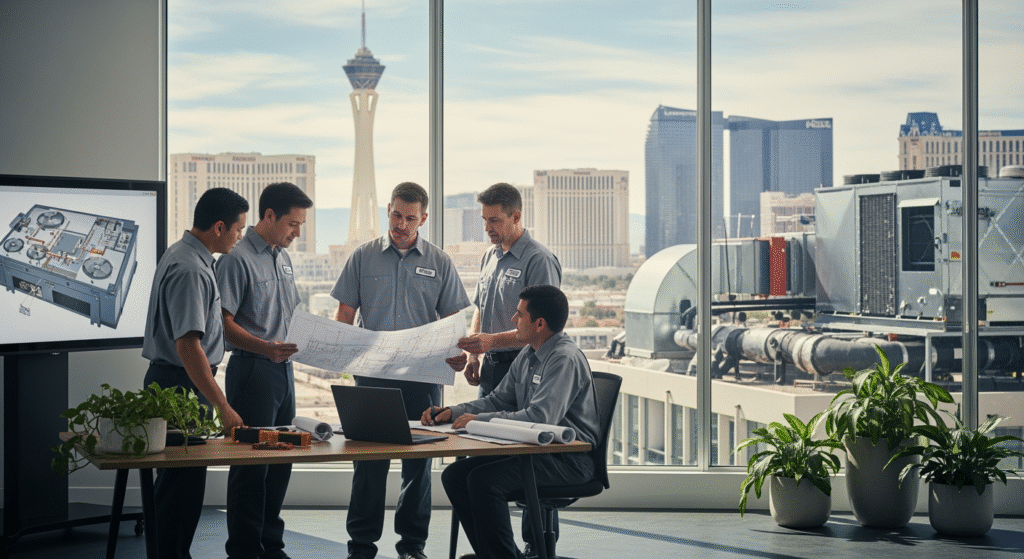
When a rooftop unit fails on the hottest day of the year, you need reliable help fast — that’s where commercial hvac contractors Las Vegas come in. I’ve worked with building owners and facility teams across the valley long enough to know the difference between a quick fix and a long-term solution. For context on energy and efficiency trends that affect decisions in commercial buildings, the U.S. Department of Energy is a useful reference for best practices and incentives: Energy.gov.
Why commercial HVAC matters in Las Vegas
Las Vegas is an extreme climate for cooling systems. Extended heat, high occupancy at entertainment venues, and unique building types like casinos, hotels, and shopping centers create heavy and often unpredictable loads on HVAC systems. Poorly designed or poorly serviced systems don’t just make employees and customers uncomfortable — they drive utility costs through the roof and risk downtime that can impact revenue. I always tell clients that a well-planned HVAC approach pays for itself over time through lower energy bills, improved indoor air quality, and reduced emergency repairs.
What commercial HVAC contractors in Las Vegas should offer
Not every contractor is built to handle commercial scale. When I evaluate teams, I look for an array of services that reflect real-world needs for businesses in this market:
- Design and build services for rooftop units, chiller plants, and packaged systems
- Preventive maintenance programs tailored to commercial schedules and occupancy patterns
- Controls and building automation installation and optimization
- Refrigeration services for walk-in coolers, cold rooms, and food-service areas
A full-service contractor brings technicians who are factory-trained, access to replacement parts for major commercial brands, and the ability to coordinate with electrical and mechanical trades during larger projects. Also important: familiarity with local code updates and energy-efficiency incentives that affect capital projects in the city.
Key questions to ask before hiring
Before you sign a contract, run through a short checklist with any prospective contractor. These questions help reveal experience, capacity, and problem-solving approach:
- Can you show commercial references from similar-sized properties in Las Vegas or nearby communities?
- Do you offer 24/7 emergency response and guaranteed response times?
- How do you handle subcontractors, permits, and code compliance on retrofit projects?
- Can you provide a preventive maintenance plan with documented checklists and reporting?
Answers should be specific and backed by examples. Vague assurances are a red flag when you’re dealing with high-stakes commercial systems.
Services commercial contractors typically provide
Understanding the full range of services helps you match provider capability to your facility’s needs. Typical offerings include:
Installation and retrofit
From rooftop units to complex chiller plants, contractors should manage equipment selection, ductwork, electrical tie-ins, and testing and balancing. Retrofits often include upgrades to variable-speed drives and high-efficiency condensers to reduce operating costs.
Refrigeration and specialty systems
Restaurants, grocery stores, and cold storage require technicians who understand commercial refrigeration circuits, brazing, and refrigerant management protocols. Properly sized refrigeration keeps food safe and prevents expensive spoilage.
Controls and building automation
Smart controls are now expected in larger commercial buildings. A contractor should program schedules, optimize setpoints, and integrate systems so HVAC works with lighting and occupancy sensors to reduce waste.
Preventive maintenance and service agreements
Regular service catches small issues before they become emergencies. Maintenance agreements typically include seasonal tune-ups, filter replacements, refrigerant checks, and documented reports that show trends over time.
Trending topics every property manager should know
Two trends are shaping the commercial HVAC market right now and they should influence how you plan upgrades:
Electrification and efficiency upgrades
With decarbonization goals and incentives from federal and state programs, building owners are increasingly moving toward high-efficiency electric systems and heat pump solutions where feasible. These upgrades often come with rebate opportunities and can significantly lower lifecycle costs.
Smart controls, IoT, and demand response
Connected controls and demand-response participation help reduce peak electricity charges. Systems that automatically adjust setpoints during utility events save money and can generate revenue through incentive programs. Contractors who can install and commission these integrations add measurable value.
Local considerations in the city and surrounding neighborhoods
Las Vegas’ building stock is diverse. A downtown office building around Fremont Street has different needs than a resort on the Strip or a distribution center in North Las Vegas. I recommend choosing contractors with proven experience in your specific neighborhood, whether that’s Summerlin, Henderson, or the airport corridor near Harry Reid International. Local knowledge matters for permit timelines, supplier access, and seasonal load forecasting.
Cost expectations and budgeting tips
Commercial HVAC budgets vary widely depending on system complexity, age, and efficiency goals. Here are practical tips I share with owners to control costs without sacrificing reliability:
- Prioritize preventive maintenance to extend equipment life and avoid high emergency repair costs.
- Bundle upgrades into planned capital projects to take advantage of contractor mobilization and potential incentives.
- Request life-cycle cost estimates rather than selecting by first-cost alone—higher-efficiency units often save more over five years.
- Ask contractors for a phased plan to spread capital expenses across fiscal years.
How to evaluate bids and contracts
Bids should be clear and comparable. Avoid accepting the lowest quote without reviewing scope details. Here’s a practical way I break down proposals for facility teams:
- Confirm the equipment make and model, warranty coverage, and what’s excluded (e.g., electrical upgrades, structural work).
- Check projected lead times for equipment—commercial parts can have longer lead times than residential items.
- Review service agreement terms, response-time guarantees, and how emergency calls are billed.
- Ensure the proposal includes testing and balancing, commissioning reports, and as-built documentation for future maintenance.
Common commercial HVAC problems in Las Vegas and quick fixes
I’ve seen the same issues recur across many properties here. Recognizing them early helps your team act fast:
Reduced cooling capacity
Causes include low refrigerant, dirty coils, or failing compressors. Quick fixes: clean coils, verify refrigerant charge, and replace filters promptly. If capacity loss continues, schedule a professional diagnostic to avoid running compressors into failure.
Poor airflow or uneven zones
Often due to duct leakage, failed VAV boxes, or improper balancing. A contractor should perform testing and balancing and seal ductwork where needed.
Control malfunctions
Outdated or poorly integrated controls create comfort complaints and wasted energy. Upgrading controllers and resetting schedules can produce immediate savings.
Actionable maintenance checklist for facility teams
Here’s a short checklist I recommend for quarterly preventive maintenance that keeps systems reliable through the hottest months:
- Inspect and change filters, check belts and pulleys, and lubricate moving parts where required.
- Clean condenser and evaporator coils, and remove debris around rooftop units to ensure proper airflow.
- Verify refrigerant pressures and electrical connections; tighten and document any irregularities.
- Test and calibrate controls and thermostats; review BAS schedules for occupancy changes.
Documenting these tasks in a shared system or log ensures continuity when staff changes and provides useful trend data for contractors.
How contractors solve specific problems — real-world examples
When a downtown office lost cooling across multiple floors, the contractor didn’t just replace a failing chiller. They analyzed load profiles, identified inefficient staging in the older control sequence, and reprogrammed the chiller logic. The result was improved comfort and a measurable drop in peak energy demand. That kind of problem-solving requires field experience, controls expertise, and good communication with building operators.
Choosing the right contractor: a simple decision framework
Use this short framework to make a confident choice:
- Verify commercial experience and ask for project references in Las Vegas or similar climates.
- Confirm trade licensing, insurance limits, and safety programs for on-site work.
- Assess technical depth—do they have controls engineers, refrigeration specialists, and a parts inventory?
- Compare warranty terms and maintenance offerings for long-term support.
The best contractors combine technical skill with clear communication and a willingness to document work in ways that facility managers can use.
Preparing for seasonal peaks and emergencies
Schedule deep maintenance in spring before cooling season peaks. For high-occupancy venues and retail centers, consider a redundancy plan: backup units, staged replacements, or temporary cooling strategies. Also discuss emergency response protocols with contractors — who will respond, expected arrival times, and escalation processes. A written emergency plan reduces downtime and protects revenue streams during critical events.
Final thoughts and next steps
Selecting the right commercial HVAC partner in Las Vegas comes down to capability, local experience, and a proactive approach to maintenance and controls. I recommend starting with a clear list of your building’s pain points, asking for detailed proposals that include testing and documentation, and prioritizing contractors with strong references in the city’s neighborhoods and commercial corridors. Planned investment in efficiency and controls not only improves comfort but can reduce operating costs and help facilities adapt to evolving energy policies and utility programs.
If you’re ready to discuss an assessment, a preventive maintenance plan, or an upgrade strategy that fits your property’s needs in Las Vegas, connect with NexTech North America for a consultation: NexTech North America.